
Italian prepositions are challenging. Hopefully, some simple examples will help you
Prepositions VS Conjunctions
Italian simple prepositions are eight, usually taught in the following order :
DI – A- DA- IN- CON -SU -PER -TRA/FRA
The role of prepositions in a sentence is to introduce some information attached to a verb or a noun, and explain their function, in the form of a “complemento”. Complements “complete” the sense of a sentence, so changing a simple preposition can change the meaning of a phrase. For example:
- Ho appena parlato di Mario. I’ve just talked about Mario.
- Ho appena parlato con Mario. I’ve just talked to Mario.
The first is a “complemento di argomento”, so the Mario was the topic of the conversation. The second is a “complemento di compagnia”, because I shared the action (parlare) with Mario.
Today’s lesson is not about complementi, however, we will use them to explain the different functions of every single preposition. Read and listen to the examples. Solve the quiz at he bottom of this page.
Preposizioni, Italian prepositions: a nearly complete guide.
This is a “freemium” Italian language blog and quiz
Please log in or subscribe for free.
Login
Subscribe
- Access to our freemium content
- Get new lessons in your inbox
- Get quiz results and score by email
- One free lesson on Skype or Zoom with a native teacher
We already said that prepositions can introduce a noun or a verb. For example:
- Penso al lavoro. I think about work.
- Penso di andare al cinema. I think I’ll go to the movies.
The main difference between preposizioni and congiunzioni is that conjunctions simply connect words, clauses or sentences together. Prepositions express relations between parts of a sentence. Sometimes, prepositions can act as simple conjunctions. As a rule of thumb…
Italian prepositions (for example di) always introduce verbs in the infinitive (e.g. studiare):
- Penso di studiare oggi pomeriggio.
Conjunctions (notably “che”) introduce verbs in the indicativo, condizionale or congiuntivo mood:
- Penso che studierò oggi pomeriggio.
Preposizioni articolate
Simple prepositions can combine with articles to form compound prepositions, or preposizioni articolate. The preposizioni articolate have the same functions of prepositions, so please remember them. The following grid is quite common on textbooks. It looks difficult, but the preposizioni articolate follow a precise pattern, so they are absolutely predictable.
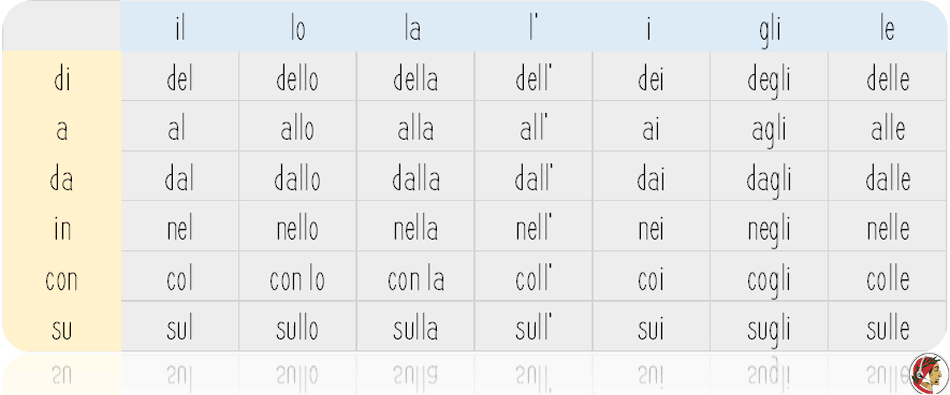
A remarkable exception is “in + the definite article” which changes into nel, nella, etc. The use of “con + article” is common in spoken Italian, much less in writing.
Prepositions with nouns
Examples are only in Italian, understanding them is your homework!
Di
Di is a very common preposition. We can roughly translate is as “of” but it covers many other meanings.
- Topic: Gli italiani parlano sempre di calcio.
- Origin: Io sono di Milano, mia moglie è di Firenze.
- Comparison: Laura è più bella di Claudia.
- Belonging: La macchina rossa è di Michele.
- Material: Ho comprato dei bicchieri di cristallo
- Time: Lavoro sempre di mattina, raramente di pomeriggio e mai di notte.
- Movement: Vado di sopra, in bagno.
A
A (to) indicates the movement, the direction of an action towards an object (indirect object) and much more.
- Time: Ci vediamo domani a mezzogiorno.
- Manner: Il mio piatto preferito è la cotoletta alla milanese.
- Quality: Morena mi ha comprato una bella camicia a quadri.
- Indirect object: Hai telefonato a Fabio?
- To place: Domani devo andare a Roma per lavoro.
- In/at place: Io e la mia ragazza studiamo a Bologna.
- Means: Non ho la macchina, quindi vado sempre al lavoro a piedi.
As opposed to English, we always need to use A to express the indirect object in Italian.
Da
DA is used to indicate movement from or to somewhere when used with andare / venire.
- From a place: Janet viene da San Francisco.
- To a place: Stasera andiamo a cena da mia madre.
- Cause: Paolo non riusciva a stare in piedi dal sonno.
- At a place: Mio figlio sta a dormire dalla sua amica.
- Through a place: L’autobus passa da Parma e si ferma a Modena.
- Agent: “Rigoletto” è stato scritto da Giuseppe Verdi.
- Value: Hai una banconota da dieci euro?
- Since: Conosco Luciana da molti anni.
- Function: Ho comprato un nuovo coltello da cucina.
When we use a proper name, a profession, a relative we can use “da” to indicate motion or position in space.
- Martedì vado dal dottore.
In
The basic meaning of in is similar to that of English ‘in’, and more.
- ‘To’ (place): L’anno prossimo andrò a studiare in America, a Boston.
- Means: Di solito andiamo a lavorare in treno.
- ‘In’ (place): Mario vive in Olanda dal 1987.
- ‘In’ (time): Di solito andiamo in vacanza al mare in agosto.
- Matter: Mia madre ha comprato dei bellissimi piatti in ceramica.
Con
It roughly means ‘with’:
- Together: Abito con i miei genitori.
- Means: Ho preparato questa torta con le mie mani.
Su
Su indicates a position, for example ‘on, upon, above’, or a topic:
- Topic: Ho letto un articolo interessante sull’economia cinese.
- On: Ci sono quattro libri su questo tavolo.
- Approximation: La moglie di Fabrizio è una donna di Roma, sui trent’anni.
Per
It can mean “for”, “through”, “by”, “in order to”…
- Classification: I miei libri sono divisi per autore.
- Through: Sono passato per Milano ma non mi sono fermato.
- Destination: Il treno per Napoli, parte dal binario 9.
- Purpose: Giovanni lavora solo per i soldi.
Tra / Fra
These two prepositions are exactly the same.
- Between/among: Benvenuto tra noi.
- Distance in time: Ci vediamo fra un’ora a casa mia.
- Distance in space: Dobbiamo uscire dall’autostrada tra dieci chilometri.
Prepositions with verbs
Prepositions often introduce a dependent clause in the infinitive. Di, A, Da and Per, are the most commonly used in this function. There isn’t any precise rule assigning a specific preposition to a verb. You will need to learn by experience. Below, some important examples.
A
Indicates an objective, an intention, a purpose expressed by the main verb. We also use it to indicate the beginning or progression of an anctivity.
- Vado a studiare in biblioteca.
- Penso solo a imparare l’italiano.
- Abbiamo cominciato a imbiancare la casa.
- Continuiamo ad andare in vacanza in Liguria.
Da
‘Something has to be done’. Da give a passive meaning to the second verb.
- Abbiamo molto lavoro da fare.
- C’è da preparare la cena. Chi cucina?
- Vorrei qualcosa di fresco da bere.
Di
Indicates the object, or the subject of the action expressed by the main verb. It’s also used to express an intention or the end of an action.
- Penso di leggere i romanzi di Elena Ferrante.
- Abbiamo finito di ristrutturare la casa in campagna.
- Mi sembra di essere stato gentile con Michela.
- Finisci di mangiare la verdura!
Per
It means ‘in order to’, so we can combine it with pretty much all the verbs for indicating a purpose.
- Ho preso un giorno di vacanza per rilassarmi.
- Ti ho telefonato per invitarti a cena.
I hope this guide and the examples were useful to understand Italian prepositions. Thanks for reading.
LOADING QUIZ…







Great article! I still am a little confused on when to use di vs su for a topic. Clearly you use di for parlare. But when the topic is a book, article, course, etc., I sometimes see di and other times su and haven’t discovered the pattern. Are there any guidelines on this?
Thanks
DI e SU supportano entrambe il complemento di argomento.
Esistono usi consolidati (patterns) che preferiscono DI a SU e viceversa.
Molto spesso dipende dal verbo, legato dalla consuetudine a “di”. Parlare / Discutere. + di + qualcosa.
Ho letto un libro su Garibaldi. Nel caso dei libri, “di” introduce l’autore, non l’argomento, quindi usiamo “su”.
L’esperienza ti aiuterà a usare la preposizione corretta. Ciao.
the examples were very useful and helped me further understand the concepts.
Grazie.
Grazie Riccardo. Il tuo blog e’ molto utile
Prego. Ciao.
Grazie, RIccardo per aver spieghato le preposizioni. Non e’ un argomanto diretto per me.
Prego.
Mi piace questo. Gli spiegazioni sono chiari. E’ molto utile.
Prego.
Riccardo, can you explain to me one doubt:
Why there is ‘piatti in ceramica’ but ‘bicchieri di cristallo’?
They are interchangeable. “in” is more common when we describe commercial items.
Thanks Ricardo, it’s exactly what I was looking for! (long way to go for myself)
Madonna ! tante cose da ricordare!! Non ci riuscirò mai!!
Sii ottimista. Ciao.
Bello, Riccardo! Grazie mille!
Sto sequendo un corso d’italiano qui a New York addesso. Sarò in contatto ancora più tardi, se vada bene per te.
Saluti, Bonita
Ciao Bonita. Puoi ricominciare con le nostre lezioni quando vuoi! Buona giornata.